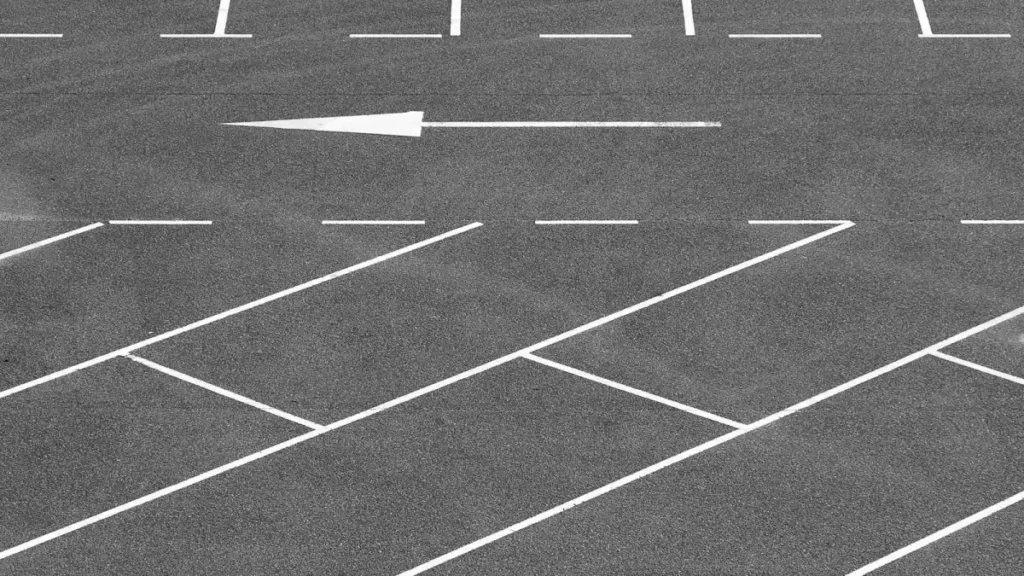
Draw the spaces on paper first: for parking at 90° each space is 2.40 × 5.00 m and the aisle in front of them is 6.00 m. Then mark out the spaces with white lines 10 cm wide, or without paint, using lane dividers, direction arrows and flexible posts. The sizes and colours come from Ordinance No. 2 of 2001 on road marking. The ordinance on designing parking spaces in the yard of a regulated plot also refers to it.
Which rules apply to marking in a private yard?
Ordinance No. 2 of 2001 on road marking applies to roads open to public use. A private yard is not such a road, but the ordinance is a good reference for sizes and colours.
When spaces are designed in the open yard area of a regulated plot, Art. 42(3) of Ordinance No. RD-02-20-2 of 2017 refers expressly to the sizes in the marking ordinance. If the yard is shared by a block of flats, allocating the spaces is a matter for the general meeting of owners. What the law says about posts and barriers outside a block of flats is described in the article on the rules outside a block of flats.
How do you plan the spaces on paper?
Start from the size of the yard and the direction in which cars come in. A scale drawing saves repainting.
- Measure the yard and mark the entrance, the exit, footpaths, manholes and columns.
- Choose the parking angle. At 90° more spaces fit, but they need the widest aisle.
- Leave an aisle in front of the spaces: 6.00 m at 90°, 4.50 m at 60° and 3.80 m at 45°.
- Divide the length of the row by the width of one space: 2.40 m at 90°, 2.80 m at 60° and 3.40 m at 45°, measured along the row.
- If a space borders a wall or a kerb higher than 15 cm, plan it at least 2.85 m wide.
- Mark where the arrows, dividers and wheel stops will go.
The full table by angle, spaces for disabled drivers and garages are in the article parking space dimensions.
| Parking angle | Space along the row | Aisle | Spaces in a 12 m row |
|---|---|---|---|
| 90° | 2.40 m | 6.00 m | 5 |
| 60° | 2.80 m | 4.50 m | 4 |
| 45° | 3.40 m | 3.80 m | 3 |
The number of spaces in the table is simply 12 m divided by the size along the row. With angled parking the first and last spaces take up a little more, so check on the drawing.
What paint and colour should you use?
Parking space lines are white and 0.10 m wide (Art. 32(2) of Ordinance No. 2 of 2001). Permanent road marking is only white and yellow, and yellow is only for zigzag lines that mark out certain areas (Art. 4).
- White – for the lines of the spaces, arrows and lettering.
- Blue with a white symbol – for a space for disabled drivers, over its whole area, with sign D21 (Art. 25 of Ordinance No. RD-02-20-2 of 2021).
- Not retroreflective – the marking of designated parking spaces does not have to be retroreflective (Art. 9 of Ordinance No. 2).
Use paint made for marking asphalt or concrete. Follow the maker's instructions on temperature, humidity and drying time, and make sure the surface is clean and dry.
How do you divide spaces without paint?
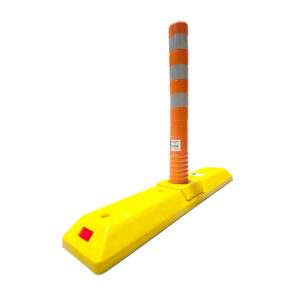
With a lane divider with a post. It goes along the line between two spaces or only at its head, and shows the boundary even when the line cannot be seen.
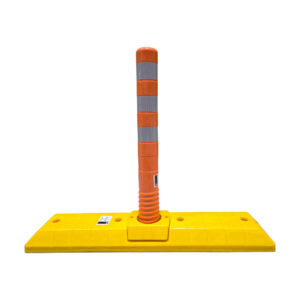
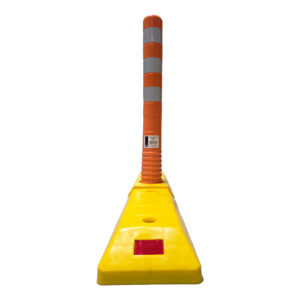
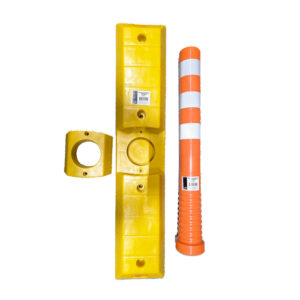
The divider in the shop is 90 × 20 × 9 cm with a 70 cm post. Decide how much of the line you want to cover:
| Method | Dividers per line | When it suits |
|---|---|---|
| Only at the head of the line | 1 pc | Painted lines, only a visible end is needed |
| Start and end | 2 pcs | No paint, the boundary shows at both ends |
| A whole 5.00 m line | 6 pcs (5.40 m) | A physical boundary, for example between a row of cars and a pedestrian area |
The post on the divider makes the end visible to a driver reversing into the space. Check how it is fixed in the product description before you buy.
How do you show the direction of traffic?
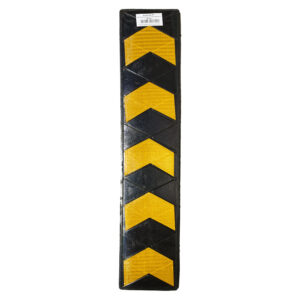
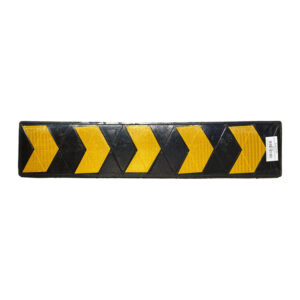
With direction arrows at the entrance, at the exit and wherever the aisle turns. In a one-way yard the arrows show where to enter and where to leave.
The arrow in the shop is 100 × 20 × 1 cm and suits indoor and outdoor use. Place it in the middle of the lane, pointing in the direction of travel, far enough ahead that the driver sees it before the turn.
How do you separate a pedestrian area or an entrance?
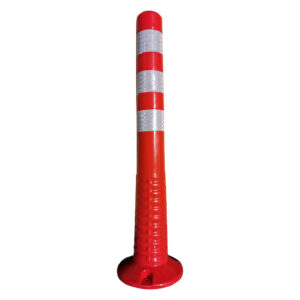
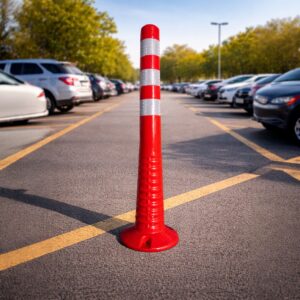
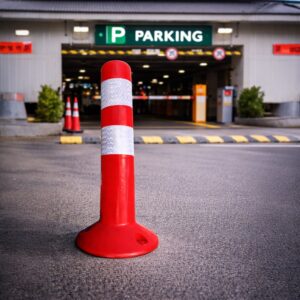
With flexible marker posts. They show a boundary without stopping the car hard: the 75 cm post springs back upright after an impact and has reflective bands.
- 75 cm post – along the edge of a footpath, in front of an entrance, around a manhole or a column.
- 45 cm post – where a lower boundary is needed or the post is moved often.
Both are made of flexible polyurethane. The posts do not reserve a space: that is what locking parking posts and barriers are for, compared in the article parking post or parking barrier.


Does every space need a wheel stop?
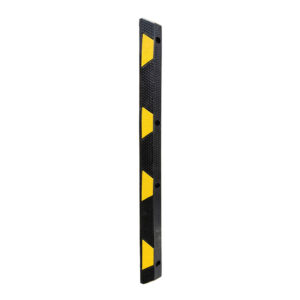
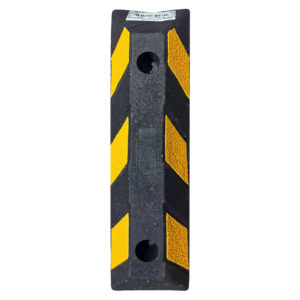
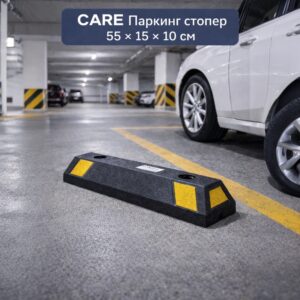
If the spaces end at a wall, a fence or a lawn, yes. A wheel stop stops the car in the same place every time and protects the fence, wall or lawn in front of it.
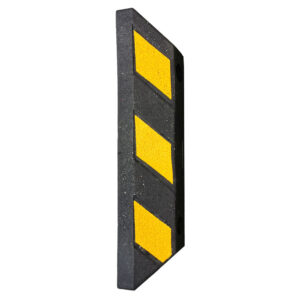
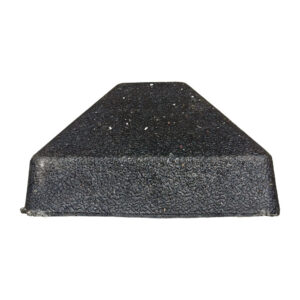
The 165 × 15 × 10 cm wheel stop is used one per space, and the 55 × 15 × 10 cm one in front of each tyre. How to choose the distance from the wall is described in the article on parking wheel stops.
Example: a yard with 4 spaces
Four spaces at 90° in one row take up 9.60 m across the front (4 × 2.40 m) and 11.00 m in depth (5.00 m space and 6.00 m aisle). Marking them out needs 5 lines of 5.00 m, 25 m of white line in total.
| Item | Quantity | Why |
|---|---|---|
| White line 10 cm | 25 m | 5 lines of 5.00 m |
| Lane divider with post | 5 pcs | One at the head of each line |
| Parking wheel stop 165 cm | 4 pcs | One per space |
| Direction arrow | 2 pcs | Entrance and exit or a turn in the aisle |
| Marker post 75 cm | 2 pcs | Edge of the footpath |
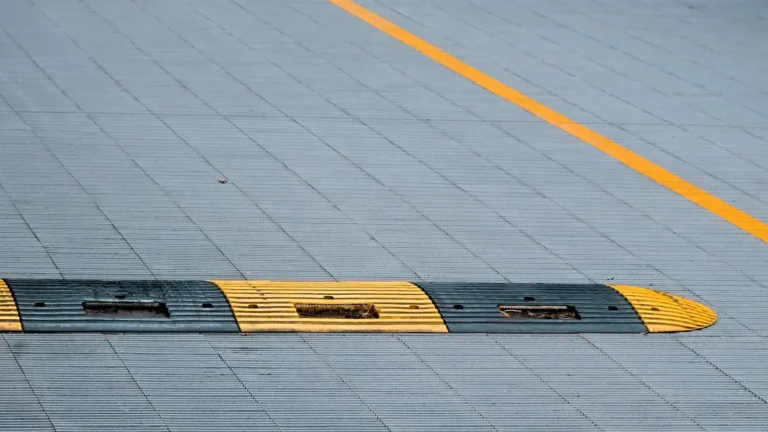
Without paint, replace the lines with dividers: 2 per line, 10 pcs in total. If the drive is long and cars come in fast, consider a rubber speed bump.
How do you maintain the marking?
Once a year, after winter, walk round the yard. Check:
- whether the lines are visible and where they need repainting;
- whether the dividers, arrows and wheel stops are firmly fixed;
- whether the posts stand upright and their bands still reflect;
- whether snow or water collects around any item.
All items for organising a yard are in the category Parking elements, and the overview by task is in the parking equipment guide.
Sources
- Ordinance No. 2 of 17.01.2001 on road signalling with road markings, Art. 1, 4, 9, 32 and Annex 24
- Ordinance No. RD-02-20-2 of 20.12.2017 on planning and design of the transport system of urbanised areas, Art. 42(3)
- Ordinance No. RD-02-20-2 of 26.01.2021 on accessibility and universal design of the accessible environment, Art. 25
Frequently asked questions
Can I mark parking spaces with yellow paint?
Under the road marking ordinance yellow is only for zigzag lines that mark out certain areas. Parking space lines are white, and a space for disabled drivers has a blue background with a white symbol.
Do I need a permit to mark spaces in a private yard?
The road marking ordinance applies to roads open to public use, not to a private yard. If the yard is shared by a block of flats, allocating the spaces is decided by the general meeting of owners.
How wide should the line between two spaces be?
The lines that mark out parking spaces are 10 cm wide. Measure the width of the space both between the centres of the lines and clear, because the difference is 10 cm.
How many dividers does one space need?
For painted lines one divider at the head of each line is enough. Without paint you need two per line, and for a continuous 5 m boundary 6 pieces of 90 cm.
What should I do with the dividers and arrows in winter?
Show the person who clears the snow where the dividers, arrows and posts are. After winter check how they are fixed.
This article is information, not legal advice.
 Parking barrier in front of a block of flats: what the law says
 Speed bump: height, speed, rules and fitting
 Parking equipment: how to organise a space, a yard and a garage