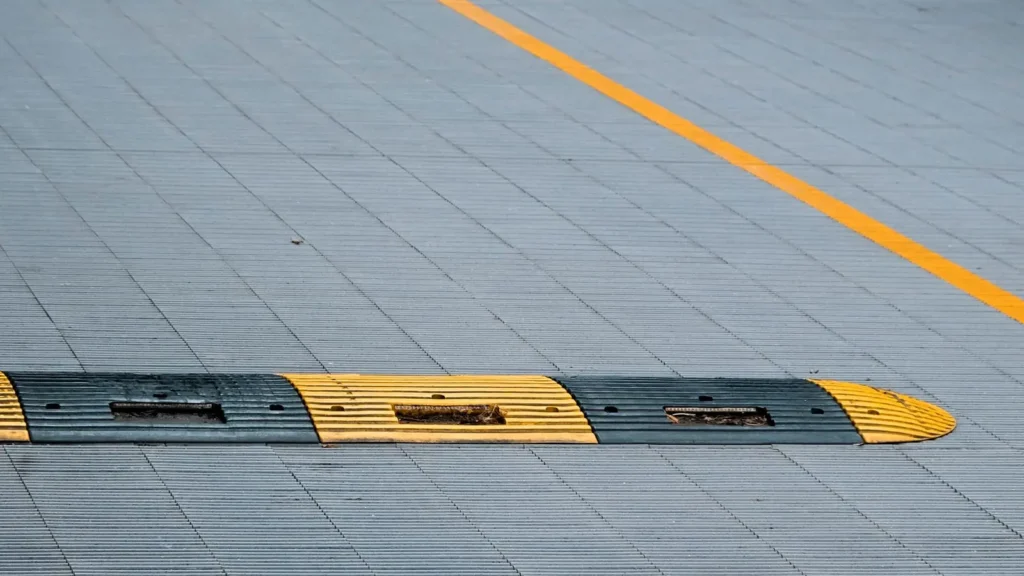
A rubber speed bump 5 cm high brings cars down to about 16–30 km/h, depending on the maker's data. On a public street a speed bump may only be installed by decision of the road owner (for streets, the municipality) and to a design approved under Ordinance No. RD-02-21-1 of 2024. In a private yard, company car park or warehouse, the owner decides. For one lane you need one 100 cm module per metre of width and two end caps.
This article is part of the guide to parking equipment for yards, car parks and garages. Here you will find the difference between a public street and private property, heights and speeds, how to count the modules, and how to fit them.
Public street or private yard: what is the difference?
The ordinance on speed bumps applies to roads open to public use. A private yard, company car park or warehouse is not such a road, so the property owner decides there.
As of November 2026, under Ordinance No. RD-02-21-1 of 1 October 2024 (in force from 15.10.2024), the rules apply to national roads of class I to III, to local roads and to streets of the primary and secondary network (Art. 1(2)). Speed bumps are not allowed on national roads outside settlements (Art. 1(3)).
- Speed reduction measures are decided by the owner or the authority that manages the road (Art. 3(3)).
- In settlements they are set by a general traffic plan or by a project for the specific case (Art. 3(2)).
- The design is made by a designer with full design competence (Art. 38) and approved by the competent authorities (Art. 39).
- Existing bumps that cannot be brought into line are removed (§ 2 of the transitional provisions).
The 2024 ordinance repealed the earlier Ordinance No. RD-02-20-10 of 2012, parts of which the Supreme Administrative Court had annulled earlier in 2024. Many articles online still quote the old ordinance. Check the current version before you file a request.
So you cannot put a speed bump on the street in front of your house or your block of flats yourself. You can file a request with the municipality. In Sofia, the city council's traffic ordinance forbids placing such devices outside the set procedure. For the yard of a block of flats, see the article on the rules for a parking space in front of the block.
What height, and down to what speed?
The higher the bump, the slower cars have to cross it. The exact speed also depends on its width and profile, so makers give different figures for the same height.
| Height of the rubber module | Recommended speed according to makers |
|---|---|
| 5 cm | from about 16 to 30 km/h |
| 7.5 cm | from about 8 to 15 km/h |
The 2024 ordinance describes a different kind of bump: a hump 3–5 m long in the direction of travel, usually built into the road surface. Its height depends on the target speed (Art. 12, Table 1):
| Target speed | Height of the hump | Ramp gradient |
|---|---|---|
| up to 40 km/h, street | 50–80 mm | 5–8 % |
| up to 30 km/h, street | 60–100 mm | 6–9 % |
| up to 20 km/h, residential zone | 100–120 mm | 8–10 % |
A rubber module is only 35 cm wide in the direction of travel. At the same height it feels sharper than a long hump.
Where does it make sense in a yard, car park or warehouse?
Where cars meet people or pull out into a place they cannot see.
- At the entrance and exit of a yard or company car park.
- Before a footpath, a building entrance or a play area in a gated complex.
- At the exit of a garage or ramp, where the driver cannot see the pavement.
- In a warehouse or loading area where people and forklifts move.
Do not put a speed bump on a bend, on a steep slope or right in front of a door that opens outwards. Drivers must see it before they reach it.
How many modules and end caps do you need?
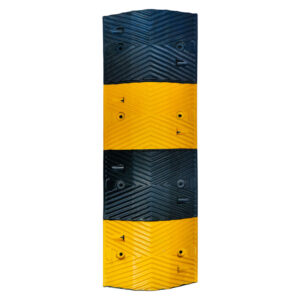
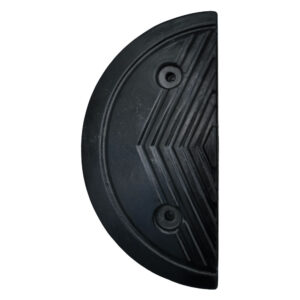
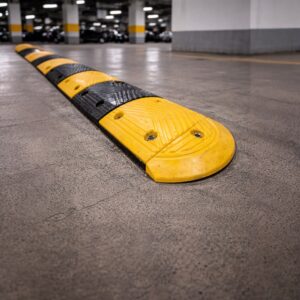
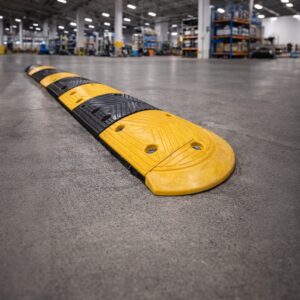
One module for every metre of width you want to cover, plus two end caps. The module is 100 × 35 × 5 cm and the cap is 35 × 5 × 17 cm, so each cap adds about 17 cm to the row.
| Width to cover | Modules | Caps | Total length |
|---|---|---|---|
| 3 m | 3 | 2 | about 3.34 m |
| 4 m | 4 | 2 | about 4.34 m |
| 5 m | 5 | 2 | about 5.34 m |
| 6 m | 6 | 2 | about 6.34 m |
If the driveway is exactly 5 m between two kerbs, 5 modules with caps will not fit. Use 4 modules with caps. That leaves about 66 cm; split it between both sides so that water can drain along the kerbs.
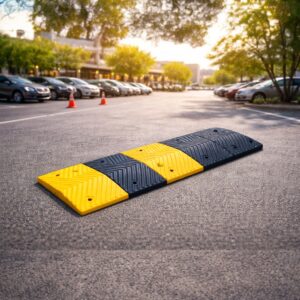
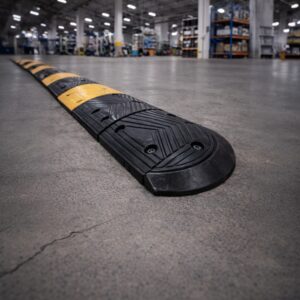
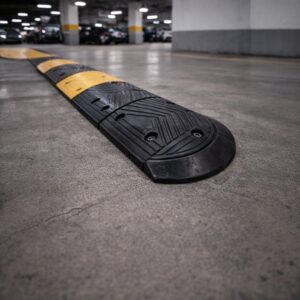
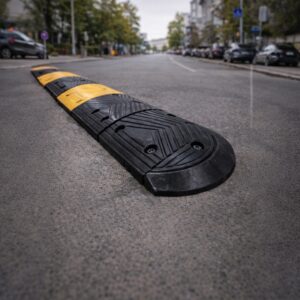
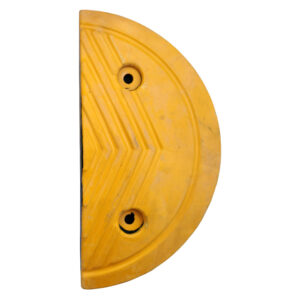
The black and the yellow end caps belong to the same series as the module and close both ends of the row:
How do you fit a rubber speed bump?
The 100 × 35 × 5 cm rubber speed bump is fixed with anchor bolts. Before buying, check in the description how many holes the module has and whether the bolts are included. If not, buy anchors to suit the base.
- Secure the area with cones and stop the traffic.
- Draw a line at right angles to the direction of travel.
- Clean the surface. The base must be firm and level, without cracks.
- Lay out the modules and end caps dry and check there are no gaps between them.
- Mark the holes, drill and clear out the dust.
- Insert the anchors and tighten evenly, starting from the middle.
- Drive over slowly and check that no module moves.
On thin or cracked asphalt the anchors work loose. Repair the surface there first. How to fix a rubber element on asphalt and concrete is explained in detail in the article on fitting a parking wheel stop.
Visibility, signs and lighting
A speed bump must be visible by day and by night. The ordinance requires this on public roads (Art. 19(1)); in a private yard it is a matter of safety.
- Alternate black and yellow modules, or put yellow end caps at the ends.
- Light the spot if the yard is used in the evening.
- Put up a sign at the entrance warning of the bump, or mark the spot with paint. How to mark a yard, see the article how to mark parking spaces.
Maintenance and winter
Check the bolts regularly, and always after winter. A loose module shifts and starts knocking when cars cross it.
A snow plough blade can catch the modules and tear them off. Warn the company that clears the yard, or mark the spot with posts before snow. Do not let ice and snow build up in front of the modules, because cars skid when braking.
This article is information, not legal advice. Regulations change, so check the current version on lex.bg or with your municipality.
Sources
- Ordinance No. RD-02-21-1 of 1 October 2024 on the conditions for building or installing speed bumps and other speed reduction measures on the carriageway and the requirements for them (State Gazette No. 87 of 2024)
- Ordinance No. RD-02-20-10 of 5 July 2012, repealed from 15.10.2024
- Ordinance on traffic organisation in the Sofia Municipality
- RS PRO, data sheet of a 5 cm rubber speed bump
- Merlin Industrial, speed bumps
Frequently asked questions
Can I put a speed bump in front of my block of flats?
On the municipal street in front of the block, no: the municipality decides that, based on a design. In the yard of the block, if it is a common part of the building, the decision is made by the general meeting of owners.
What is the maximum height of a speed bump?
For public streets the 2024 ordinance sets 50–100 mm for a hump on street sections and up to 120 mm in residential zones. There is no rule for a private yard. Our rubber module is 5 cm high.
Do I need a permit for a speed bump in a company car park?
The speed bump ordinance does not apply to private property that is not a road open to public use. If the car park is open to public use, ask the municipality.
Does a rubber speed bump get in the way of ambulances and fire engines?
A low 5 cm module can be crossed slowly by large vehicles too. Do not put bumps on the fire access route to a building without advice from a specialist.
What are the end caps for?
They close the ends of the row, make them rounded and visible, and protect the modules from wear. Each row needs two end caps, one for each end.
 Parking space dimensions in Bulgaria: width, length and aisle
 How to mark parking spaces in a yard: paint, dividers, arrows
 Parking barrier in front of a block of flats: what the law says