
A parking wheel stop stops the tyre, not the bumper. Bulgaria has no rule for its distance from the wall, so work it out from your own car: measure how far the bumper sticks out in front of the tyre at the height of the stop and add a 10–20 cm margin. For one car, two stops of 55 cm (100 cm for a low bumper) or one of 165 cm are enough. On concrete the stop is fixed with anchors, on asphalt with long spikes or anchors.
This article is part of the guide to parking equipment for yards, car parks and garages. Here you will find how to choose the size, how to measure where the stop goes and how to fit it on different surfaces.
What does a parking wheel stop do, and what does it not do?
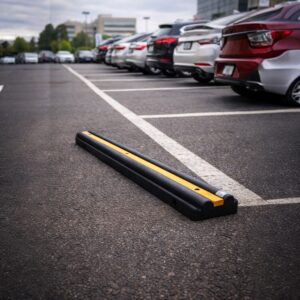
A wheel stop is a low kerb that the tyre touches when the car has reached the right spot. The driver feels the resistance and stops.
- It protects the wall, the garage door, shelves and appliances behind the car from the bumper.
- It makes the car stop in the same place every time, for example to keep a path to the door free.
- In an open car park it keeps the car off the pavement and out of the space in front.
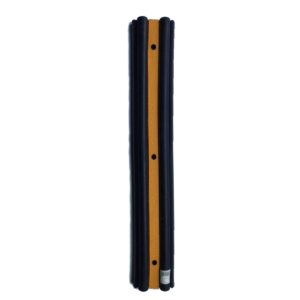
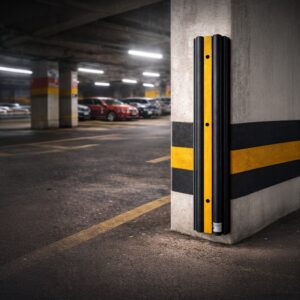
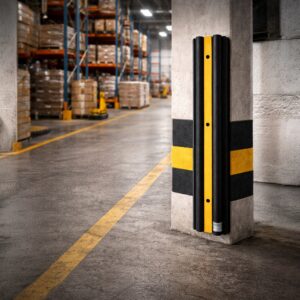
A wheel stop is not a barrier. It does not stop a car coming in at speed, and it does not protect the doors at the side. Bollards and parking barriers keep a space free; a wall protection strip protects the doors.
55, 100 or 165 cm: which stop for which space?
The choice depends on whether you want one stop under each tyre or one stop for the whole car, and on how low your bumper is.
| Stop | Size | Height | When to choose it |
|---|---|---|---|
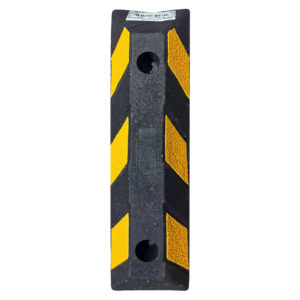
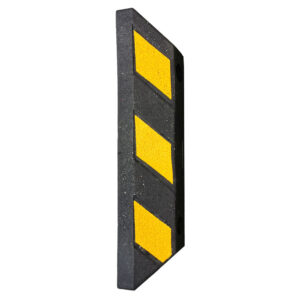
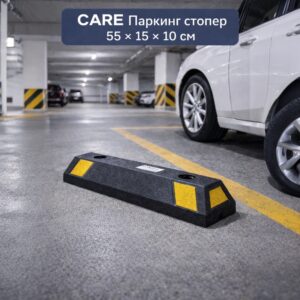
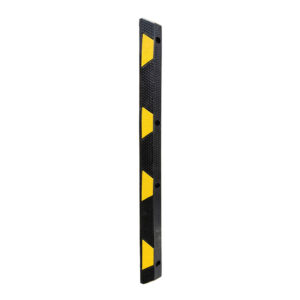
| Short | 55 × 15 × 10 cm | 10 cm | One under each tyre: two per car. Suits a garage or a space next to a wall. |
| Low | 100 × 16 × 5 cm | 5 cm | Cars with a low bumper or spoiler: one under each tyre. Garages, warehouses. |
| Long | 165 × 15 × 10 cm | 10 cm | One stop for both tyres. Suits yards and open car parks. |
A perpendicular parking space is 2.40 m wide under Annex No. 24 to Ordinance No. 2/2001 (details in the article on parking space dimensions). A 165 cm stop placed in the middle of such a space leaves about 37.5 cm on each side.
Before you choose a long stop, measure the distance between the outer edges of the two tyres on one axle. If it is more than 165 cm, use two short stops. If your bumper is low, do a test: put a board or a brick as high as the stop in front of the tyre and drive up slowly. If the bumper passes over it, it will pass over the stop. If it touches, choose the low 5 cm stop.
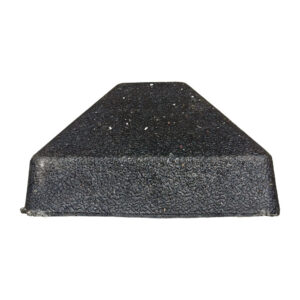
All three stops are in the category Parking elements:
How far from the wall should the stop go?
As far as your car overhangs in front of the tyre, plus a 10–20 cm margin. There is no single figure: we found no rule in Bulgarian regulations for the position of a wheel stop, and the overhang differs from car to car.
- Park on level ground with the wheels straight.
- Put an object as high as the stop (10 or 5 cm) in front of the tyre that will touch the stop, so that it rests against the tyre.
- With a plumb line or a square, transfer the most protruding point of the bumper to the floor. Include the number plate, the tow bar and the spoiler.
- Measure horizontally from the object to that point. This is the overhang over the stop.
- Add a 10–20 cm margin. If you walk in front of the car, also add the width of the path you need.
- Measure the total from the wall and draw a line. The side of the stop that the tyre touches goes on this line.
If you reverse in, measure from the rear tyre to the rear bumper or the tow bar. The rear overhang is often longer than the front one. If different cars use the space, measure the car with the longest overhang.
As a reference: Annex No. 24 to Ordinance No. 2/2001 shortens a perpendicular space from 5.00 m to 4.50 m where the car can overhang the kerb. In other words, the ordinance assumes about 0.50 m of overhang. This is a reference for the size of the space, not a rule for the stop.
Before drilling, draw the line in chalk, lay the stop loosely and park two or three times. Also check that the garage door closes behind the car.
How do you fit a parking wheel stop on concrete?
With anchors in drilled holes. Before buying, check how many holes the stop has, what bolt diameter they take and whether fixings are in the box. If not, buy concrete anchors long enough for the thickness of the stop and the floor.
- Secure the area, for example with a 70 cm traffic cone.
- Clean the floor and check with a spirit level that it is flat under the stop.
- Place the stop on the line you drew and mark the holes.
- Drill with a hammer drill to the depth given by the anchor maker.
- Clear the dust out of the holes.
- Insert the anchors and tighten evenly, without over-tightening.
In a garage with underfloor heating or a waterproofing layer under the screed, check the drawings before drilling. There, gluing may be the safer option.
Fitting on asphalt: spikes, anchors or a concrete base?
On thick, firm asphalt the stop is fixed with long spikes or with bolts in shields. On thin asphalt that crumbles, lay a concrete base under the stop.
One maker of rubber wheel stops gives the following sizes in its guide. They are for its own product and serve as a reference. For our stops, check the diameter of the holes.
| Base | Fixing | Hole | Note |
|---|---|---|---|
| Concrete or asphalt | Bolt of about 12 mm, about 200 mm long, with a metal shield | About 19 mm, 7.5–10 cm deep | Do not over-tighten. |
| Asphalt only | Rebar spike of about 12 mm, about 355 mm long | About 12 mm, 7.5–10 cm deep | Do not over-drive. |
| Any firm base | Construction adhesive | No holes | An alternative to fixings. |
The same guide recommends 3–5 fixings for a stop 1.83 m long.
Paving and slabs: what to watch out for?
An anchor in a single slab or paving block loads only that block. It can work loose or crack.
It is safer if the fixing reaches the firm base under the paving. The other option is to lift the blocks where the stop goes and pour a strip of concrete. If the paving is laid on sand with no concrete underneath, plan the concrete strip from the start.
The most common fitting mistakes
- The distance was measured to the tyre, not to the most protruding point of the bumper.
- The stop is not centred on the tyres and the car ends up crooked.
- The base is uneven: the stop rocks and the fixings work loose.
- The bolts are over-tightened and the stop deforms around the holes.
- The stop blocks rainwater draining off the yard.
- Nobody tested with the car before drilling.
Do you need a wheel stop or a wall protection strip?
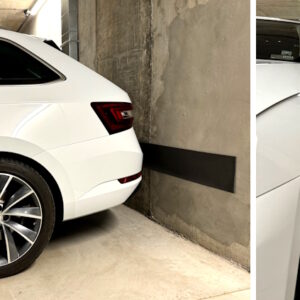
The stop protects the front and back of the car; the strip protects the side wall where you open the door. In a narrow garage you often need both.
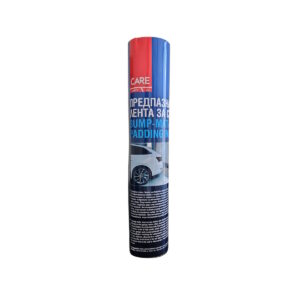
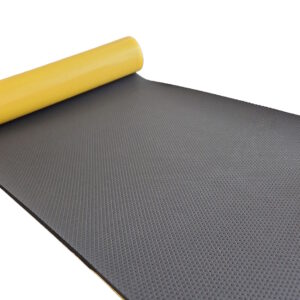
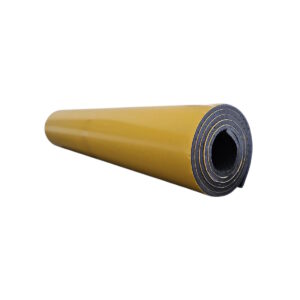
How to choose the height and size of the strip is explained in the article on protective strip for a garage wall. If you are laying out a whole yard, see also how to mark parking spaces.

Sources
- Ordinance No. 2 of 17.01.2001 on road marking, Art. 32 and Annex No. 24 (text as of November 2026; check the current version)
- RubberForm, wheel stop installation guide, 2008
Frequently asked questions
How far from the wall does a parking wheel stop go?
As far as the bumper sticks out in front of the tyre at the height of the stop, plus a 10–20 cm margin. Bulgaria has no single-figure rule, so measure your own car.
Do I need two stops or one long one?
Both work. Two short stops of 55 cm can be set for any car, while one of 165 cm is a single item to fit and is easier to see.
Can I glue the stop instead of drilling?
Yes, with construction adhesive on a clean, dry and firm base. This is handy in a garage with underfloor heating, but if the stop is hit often, anchors hold more reliably.
Do wheel stops damage tyres or bumpers?
The tyre is not damaged if you drive up slowly. A low bumper can catch the stop, so do a test with a board as high as the stop.
Do I need a permit for a parking wheel stop?
In your own garage or yard, it is your decision. In a shared garage or yard of a block of flats, the use of the common parts is decided by the general meeting of owners.
 Parking equipment: how to organise a space, a yard and a garage
 Parking bollard or parking barrier: which to choose
 Traffic cone 30, 50 or 70 cm: which size you need