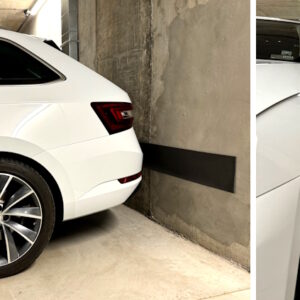
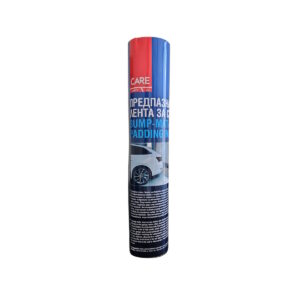
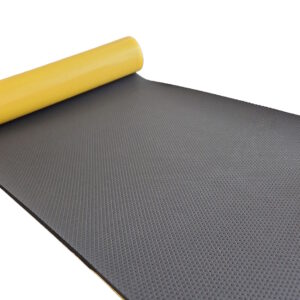
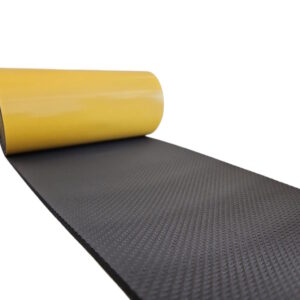
A wall protector strip goes on the wall exactly where the edge of the open door touches it. There is no standard height, because it depends on the car. Open the door slowly towards the wall, mark the most protruding point of its edge and stick the strip so that this point is in its middle. The CARE S, M and L strips are self-adhesive and waterproof.
This article is part of the guide to parking equipment for yards, car parks and garages. Here we explain how to choose and fit a strip, an edge guard or a door protector so that both the door and the wall stay undamaged.
Why does the door hit the garage wall?
Because little room is left between the car and the wall. Under Article 42(4) of Ordinance No. RD-02-20-2 of 2017 a single garage must have clear internal dimensions of at least 2.75 × 5.50 m, and 10 % less is allowed when an existing building is converted. Much of those 2.75 m is taken by the car itself.
For an open-air space at 90° the width is 2.40 m, and where there is a wall or kerb higher than 0.15 m on one side, the space must be at least 2.85 m wide. More on these sizes is in the article on parking space dimensions. In a narrow garage the door edge easily reaches the wall.
Check the width of your car in the technical data of the model. Subtract it from the width of the garage and you will see how much room is left for the doors on both sides.
Strip, edge guard or door protector: which for which place?
A strip protects a flat wall, an edge guard protects a corner or a column, and a door protector protects the car itself wherever you park.
| What you protect | Solution | Why |
|---|---|---|
| Flat wall next to the driver's or passenger's door | Wall protector strip | Covers the zone where the door edge touches the wall. |
| Corner at the entrance, column in an underground car park | Edge guard | Covers the edge of the column or corner, where bumpers and wings pass closest. |
| The car door in any car park | Door protectors | Fitted on the door edge, they protect against other people's walls and cars too. |
How do you find the right height for the strip?
Measure it on your own car, in your own garage. There is no standard height, because the doors of different cars differ in shape and height.
- Park the car where it usually stands. If you have a wheel stop, stop against it.
- Open the door slowly until its edge almost touches the wall.
- Find the most protruding point of the door edge, that is, the point that will hit the wall first.
- Mark this point on the wall with masking tape, together with its position along the wall.
- Repeat for the rear door and for every car that parks in the garage.
- Measure the lowest and the highest marked point from the floor. The distance between them is the zone the strip must cover.
- Choose a strip that covers this zone with a margin above and below, and stick it so that the marked points are in its middle.
If the car stops in a different place each time, the point of impact on the wall moves as well. A wheel stop on the floor then helps the car stop in the same place. How to choose and fit one is explained in the article on the parking wheel stop.
Which size to choose: S, M or L?
Choose by the zone you measured: a small strip is enough for one point of impact, while doors of two cars or a long wall need a larger one.
| Size | Dimensions as described | When |
|---|---|---|
| S | 60 × 20 cm | one door and a small impact zone |
| M | 40 × 100 cm | a taller zone, for example doors of two different cars |
| L | 20 × 200 cm | a long band along the wall for the front and rear doors |
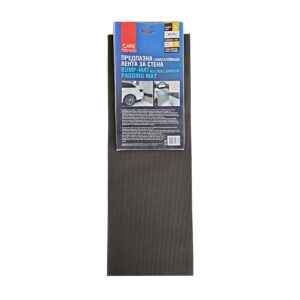
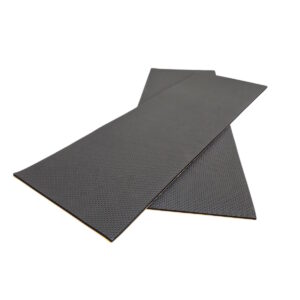
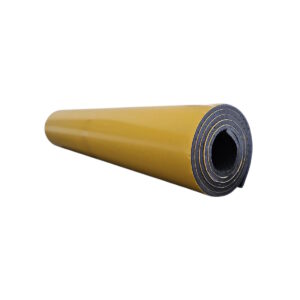
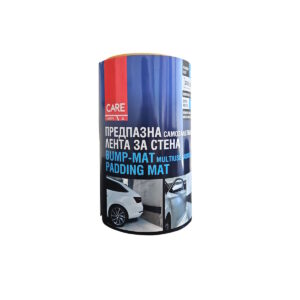
The strips can be cut to the length you need, so you can divide one strip into several pieces for different spots. The three sizes are here:

How do you prepare the wall and stick the strip?
The adhesive holds only as well as the surface beneath it. So a clean, sound wall matters more than the strip itself.
- Remove the dust from the wall with a dry cloth or brush.
- Check that the paint or plaster is not flaking. If it is, repair it first.
- Stick the strip in dry weather, when the wall is not damp.
- Cut the strip to the length you need.
- Peel the protective film off the back and press the strip onto the wall over its whole area.
The adhesive on self-adhesive strips can weaken in direct sun and at high temperatures. If the wall is heated by the sun, check the strip during the summer.
Columns and corners: when is an edge guard better?
When the knocks come not from the door but from the bumper or wing while driving in and manoeuvring. Then you protect the corner, not the flat wall.
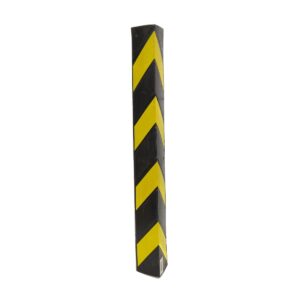
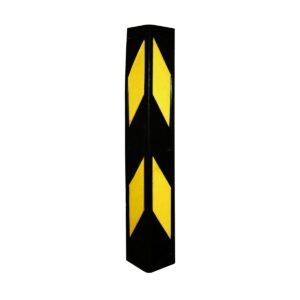
CARE edge guards are made of rubber, which absorbs the impact and protects both the car and the surface. The 60 cm model is black with yellow warning stripes that improve visibility. Choose the length by the section you want to cover.
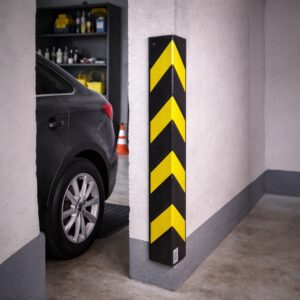
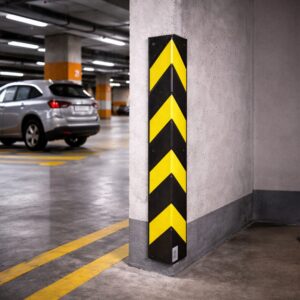
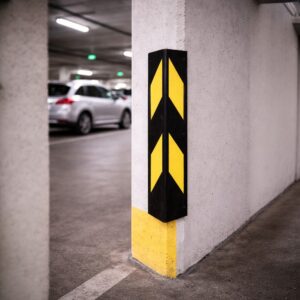
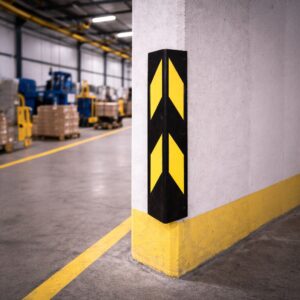
Columns and walls in the underground car park of a residential building may be common parts. Before sticking or drilling on the columns, ask the building manager. Why this matters is explained in the article on the rules for parking spaces in a condominium.
Door protectors: when you park in different places
A strip protects only your own wall. If you park at work, in a shopping car park or next to other cars, it is more useful to protect the door edge.
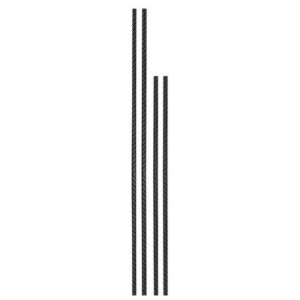
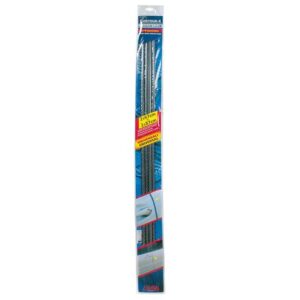
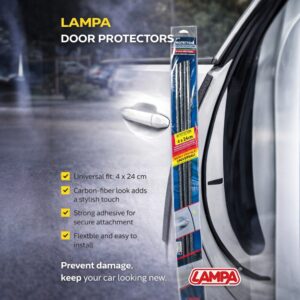
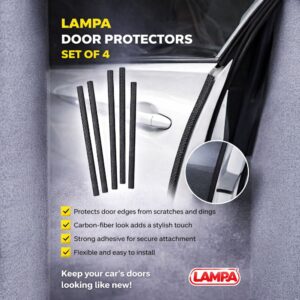
LAMPA protectors are fitted along the door edges and protect them on contact with a wall or a neighbouring car. The set has 4 pieces, enough for two doors, and is fitted without tools. Other protectors are in the category Parking elements.
Sources
- Ordinance No. RD-02-20-2 of 20.12.2017 on the planning and design of the transport system of urban areas, Article 42(4).
- Ordinance No. 2 of 17.01.2001 on road marking, Annex No. 24 (as in force in November 2026; check the current version).
Frequently asked questions
Will the strip come off in the sun or in the cold?
The descriptions do not name cold as a problem, but heat and direct sun can weaken the adhesive. Stick it on a clean, dry wall away from direct sun and check the strip after the first summer.
Can the strip be stuck on a painted wall or on plasterboard?
Yes, if the paint is sound and not flaking. Bear in mind that when you remove it, the adhesive may pull off some of the paint.
How many strips does one garage need?
Usually one for each side on which you open a door. If two cars with different doors park in the garage, measure the impact zone for each and choose a larger size or two pieces.
Do I need a wheel stop or a wall strip?
The wheel stop stops the car in the right place at the front, while the strip protects the side wall when the door opens. In a narrow garage it is useful to have both.
How do you remove the strip without leaving marks?
Peel it slowly and at a low angle, starting from one end. Clean off adhesive residue with a suitable product after testing it on a hidden spot.
Are there reflective protectors?
The descriptions of the wall strips do not mention a reflective coating. The 60 cm edge guard is black with yellow warning stripes for better visibility.
 Parking space dimensions in Bulgaria: width, length and aisle
 How to mark parking spaces in a yard: paint, dividers, arrows
 Parking barrier in front of a block of flats: what the law says